Short answer: Yes, many mini splits heat well in freezing weather, and cold climate models are built for subzero days. But the colder it gets, the less heat any heat pump can pull from the air, so a standard model can lose heating power in deep cold. The numbers depend on your exact model, so look up the outdoor temperature range in your manual before the first freeze.
Why cold air matters
A mini split heats by moving heat from the outside air into your room. The Building America Solution Center explains that all air, even very cold air, contains some heat, but the colder it is outside, the harder it is for a heat pump to pull that heat out. In especially cold weather, a heat pump that is not built for it cannot keep the space warm by itself.
Mitsubishi Electric says older heat pumps and conventional single-stage models struggled to hold the set temperature when it got very cold, and that variable-capacity systems can run the compressor faster at low outdoor temperatures.
What the makers say about low temperatures
These are manufacturer claims, not a promise for your house. They are here to show how much models differ.
| Source | What it says |
|---|---|
| Mitsubishi Electric (Hyper-Heating INVERTER models) | 100 percent of rated capacity down to 5°F, guaranteed operation down to -13°F. Select H2i plus systems reach 100 percent down to -5°F. |
| Carrier (cold climate heat pump page) | Some models operate down to -22°F or -23°F without a loss of heating power, depending on the product. |
| ENERGY STAR cold climate designation | Heat pumps must demonstrate efficient operation at 5°F and pass a control test, according to Carrier's page. |
| Daikin FTXTP-N user guide | For the RXTP outdoor units listed, the heating range runs from -30°C to 24°C (about -22°F to 75°F) on one version and -25°C to 24°C (about -13°F to 75°F) on the other. |
A standard model that is not marked cold climate can have a much higher lower limit. Do not assume yours is built for subzero weather. Look in the manual or on the outdoor unit's rating label for the heating operating range.
What you will notice on very cold days
- The unit runs longer. This is normal. It is working harder to keep up.
- Defrost cycles. Lennox says frost can start forming around 47°F, and that defrost generally takes 3 to 15 minutes. You may see steam around the outdoor unit. Warm air stops for a few minutes. See what DF means on a mini split.
- Less heat on the coldest nights. If the room slowly falls behind, that may be the unit reaching its limit.
- Protective shutoffs. A safety device can stop the unit if it runs outside its range, and Daikin warns that condensation and dripping can occur outside the range.
What to do before and during cold weather
- Check the heating range in your manual. Write down the lowest outdoor temperature it lists.
- Test heat mode early. Lennox suggests switching to HEAT before cold weather arrives to confirm the system responds.
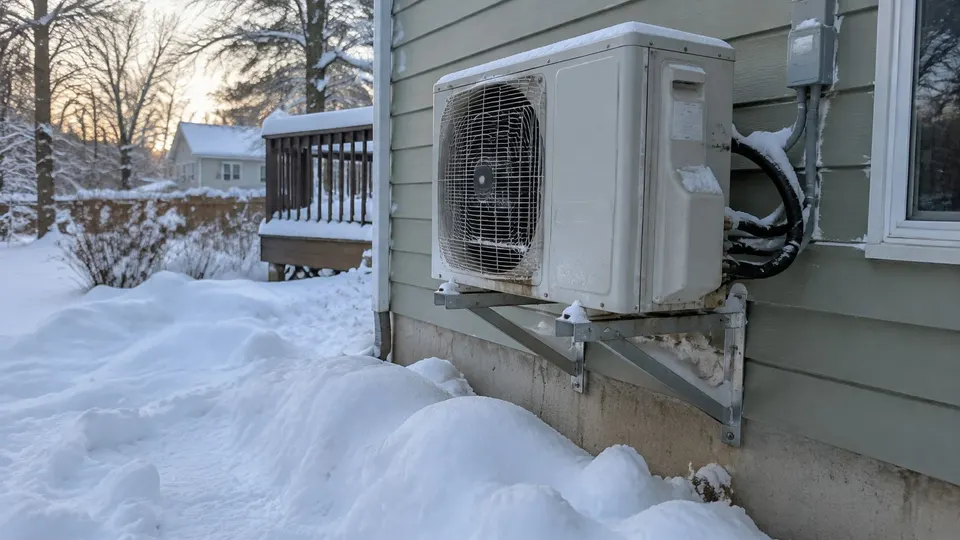
- Clear the outdoor unit. Trane says to clear snow, ice and debris from the top of the unit, and trim shrubs back two feet. Lennox recommends 24 inches of open space on all sides. Switch the unit off before you remove loose snow by hand. Do not chip ice off the coil and do not spray water into the cabinet.
- Keep the filter clean. A clogged filter cuts airflow. See how to clean a mini split.
- Set the temperature steadily. Wild swings make the unit work harder. A small, steady setting is easier for it.
- Have a backup plan for the coldest nights. If your unit is not rated for the cold you get, plan on a second heat source for those days.
What the result tells you
| What you see | Likely cause | What to do |
|---|---|---|
| Warm air stops for a few minutes, steam outside | Defrost | Wait |
| Room warms slowly on a very cold day | Normal reduced capacity | Be patient, use a backup if needed |
| Unit is off and shows a code at the coldest hour | Outside its operating range or a protection | Wait for it to warm up, then restart. Note the code. |
| Cools fine but never heats | Possible reversing valve problem (Lennox) | Call a technician |
| Defrost over 15 minutes, or repeating within an hour | Possible fault (Lennox limits) | Call a technician |
| Ice keeps building on the unit | Airflow or refrigerant problem | See why a mini split freezes up |
When to call a technician
Call a licensed HVAC technician if the unit never heats well even on mild winter days, the defrost keeps repeating, or you see ice that will not clear. See mini split not heating for the full checklist. If you are shopping for a new unit for a cold area, ask the installer for the capacity at your coldest design temperature, not just the number on the box.
Do not open the electrical box, touch the refrigerant lines or add refrigerant.
Looking after it all winter
- Keep snow off and away from the outdoor unit.
- Walk by it after every big storm.
- Book a yearly tune-up before the heating season. Trane recommends service twice a year for a system that heats and cools, once before each season.
Related reading
- For day to day settings, see winter temperature settings.
Sources
- Building America Solution Center: Cold Climate Heat Pump Sizing and Selection
- Mitsubishi Electric: Heat Pumps in Extreme Cold Climates
- Carrier: Cold Climate Heat Pump Systems
- Daikin FTXTP-N user reference guide
- Lennox: Mini split not working in heat mode
- Trane: Mini-split not working in heat mode
This is general information, not a repair manual for your exact model. Follow your unit's own manual.