Short answer: Choose a mini split breaker from the exact outdoor unit's electrical rating and installation instructions, not its BTU size alone. Minimum circuit ampacity (MCA) and maximum overcurrent protection (MOCP) have different jobs. A licensed electrician must check the model, supply, circuit and local rules. A 12,000-BTU label by itself cannot give you a safe breaker size.
Why a BTU-to-breaker table is not enough
BTU capacity describes heating or cooling output. It is not the electrical circuit specification. Two systems sold at the same nominal capacity can have different voltage requirements, compressor designs and electrical ratings.
Do not size a breaker from running watts, a plug shape, the indoor unit's label alone or an online chart that says every 12,000-BTU mini split uses one amperage. Start with the outdoor model and the manufacturer's electrical data for that exact model suffix.
This is a planning guide. It does not explain how to open a panel, select wire, connect terminals or install a breaker. Those decisions belong to the electrician using the equipment instructions and applicable code.
Step 1: Collect the rating information
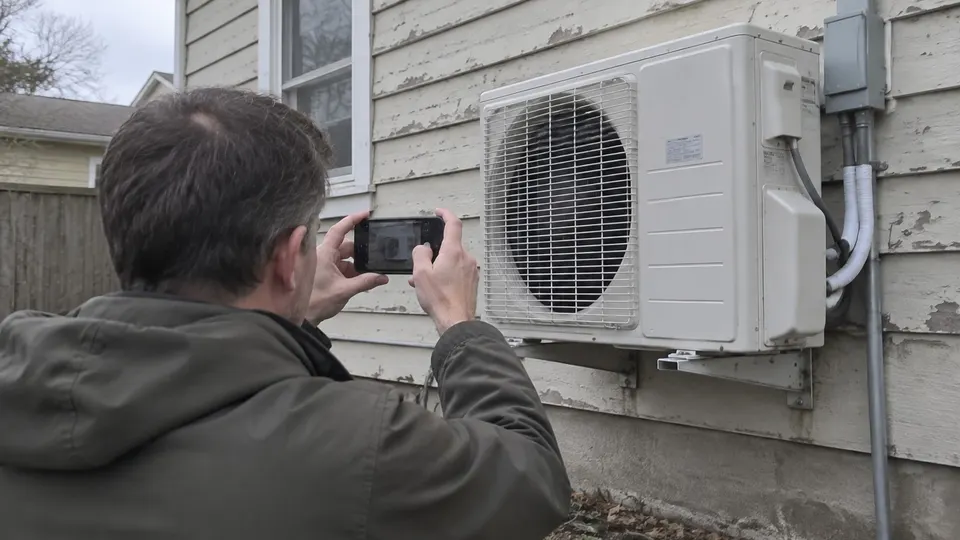
- Write down the complete outdoor model number, including the suffix.
- Record the matched indoor unit or indoor-unit combination.
- Find the manufacturer's current submittal and installation manual for that combination.
- Record supply voltage, phase and frequency, MCA, MOCP or maximum fuse/breaker rating, and any separate recommended breaker specification.
- Send the label photograph and documents to the electrician before ordering electrical materials.
Do not remove a cover to look for these values. If the external label is unreadable or the documents disagree, ask the manufacturer or installer to confirm the correct revision.
What MCA and MOCP actually tell you
| Marking | Meaning | What it does not mean |
|---|---|---|
| Supply voltage, phase and frequency | Electrical supply the equipment is designed to use | Permission to connect it to any spare circuit |
| MCA | Minimum circuit ampacity; a circuit-conductor sizing input | The breaker must equal this number |
| MOCP | Maximum overcurrent protection rating for the equipment | A measured running current or instruction to always install the maximum |
| Recommended fuse/breaker | A manufacturer recommendation that must be read with the installation requirements | A universal size for every model of that BTU capacity |
| Indoor-unit electrical rating | The indoor unit's own rating | Necessarily the outdoor supply-circuit rating |
The electrician must also account for the wiring method, installation conditions, equipment instructions and local requirements. Do not turn MCA into a wire-gauge recommendation yourself.
One exact manufacturer example
The Mitsubishi Electric Canada submittal SB_MSZ-HM12NA-(U1)(U2)_MUZ-HM12NAH-U1_202210 lists this matched wall-mounted system:
| Item | Published value |
|---|---|
| Indoor unit | MSZ-HM12NA-(U1)(U2) |
| Outdoor unit | MUZ-HM12NAH-U1 |
| Nominal cooling capacity | 12,000 BTU/h |
| Supply | 208/230 V, single-phase, 60 Hz |
| Outdoor MCA | 9 A |
| Outdoor MOCP | 15 A |
| Indoor MCA | 1.0 A |
The difference between the indoor and outdoor MCA is why reading the right label matters. These values illustrate one documented system. They are not a breaker recommendation for another Mitsubishi model, a different suffix or another brand. Verify the installed unit's label and current manual before using the example in a quote.
Step 2: Have the circuit checked before installation
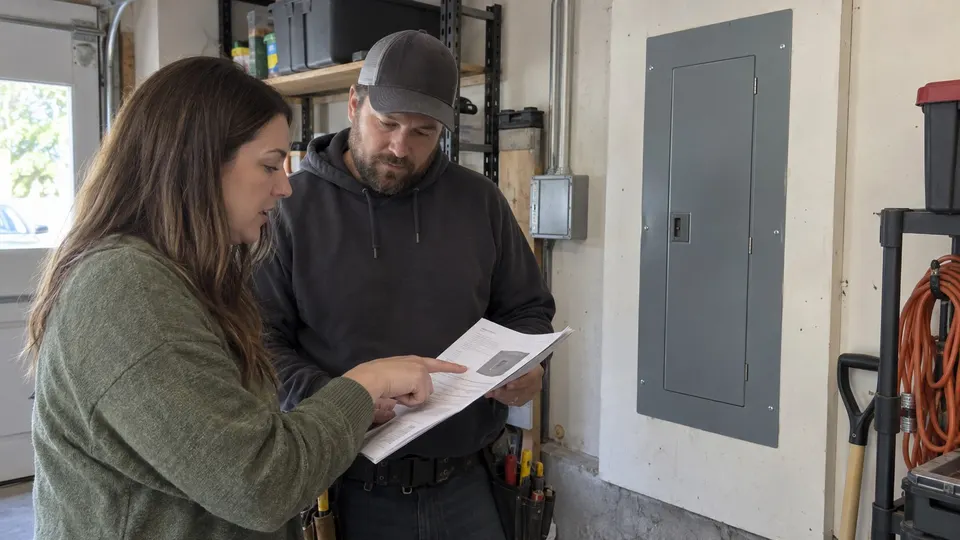
Ask the electrician to confirm:
- Does this property have the supply the exact unit needs?
- Do the proposed circuit and protection match the equipment instructions and local rules?
- Are the panel capacity, disconnect and any required protection accounted for?
- Does the quote include the full model number, permits or inspection where required, and the electrical work needed for this installation?
A spare space in a panel is not confirmation that the installation is suitable. An existing circuit needs checking too, especially if the old equipment had a different voltage or rating.
If the mini split keeps tripping its breaker
Do not fit a larger breaker just to stop the trips. Do not repeatedly reset a breaker that trips again. Stop using the system and have the cause checked. A trip is a protection event, not proof that the breaker is undersized.
Give the electrician the model, existing breaker rating, when the trip happens and any recent installation work. Do not remove panel covers or touch terminals to collect that information. For running-cost questions rather than circuit design, use the separate electricity cost guide.
Keep the paperwork
Save the rating-label photograph, submittal, installation manual and installer details together. That record helps when the unit needs service or is replaced. Keep the labels readable and leave all panel, conductor and protection changes to qualified electrical personnel.
Related reading
- Planning the install? Also read about outdoor unit clearance.
Sources
- Mitsubishi Electric Canada: exact HM12NA/HM12NAH-U1 submittal, outdoor and indoor electrical ratings.
- MRCOOL Advantage installation manual, electrical safety and manufacturer-directed circuit selection. Not a substitute for another model's installation manual.
- Mitsubishi Electric Sales Canada: MCA and MOCP explanation, hosted by Green Building Advisor, definitions only; do not use its calculation examples to size another unit.