Short answer: Daikin mini split error codes must be matched to the indoor and outdoor model, not a brand-wide list. On the ARC452A remote covered here, hold TIMER CANCEL for five seconds, then press it repeatedly until a continuous beep identifies the stored fault. Record the code before arranging service. The code names a fault category, not a confirmed failed part.
Start with the model, not the code chart
Find the indoor and outdoor model numbers on their labels. Photograph them without opening an electrical cover. Also note the remote model, usually printed on its back or under its battery cover.
This guide's code table follows the Daikin FTXS09/12H operation manual and its ARC452A-series diagnosis procedure. It is a residential split-system example. It does not cover every Daikin mini split, VRV system, chiller or furnace. Daikin's global code list spans several equipment families, so a matching letter alone is not enough.
Step 1: Read the fault with an ARC452A remote
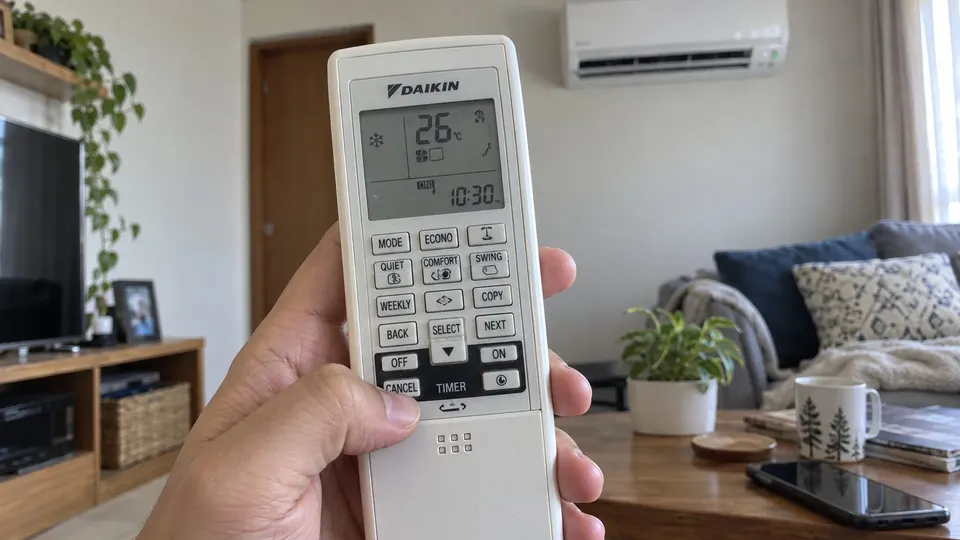
Use these steps only if your remote and operation manual support this procedure:
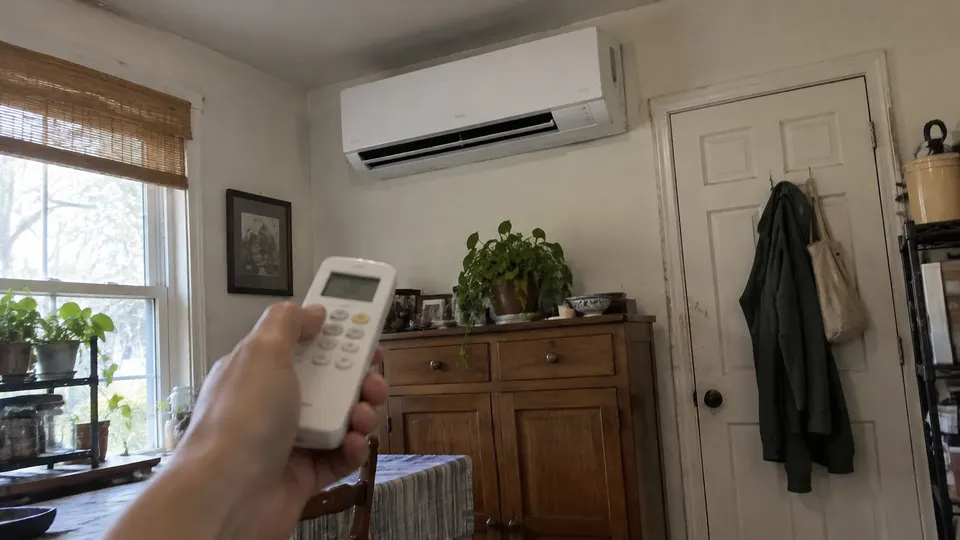
- Point the remote at the indoor unit's receiver.
- Hold TIMER CANCEL for five seconds to enter the code-check display.
- Press TIMER CANCEL repeatedly, keeping the remote aimed at the unit.
- Stop when you hear a continuous long beep. Write down the displayed code.
- Hold TIMER CANCEL for five seconds to leave the code display. In this manual, it also clears from the remote after one minute without a button press.
Short beeps or two consecutive beeps do not identify the matching fault. A code seen while cycling through the list is not automatically your unit's fault. Leaving the display is not a repair or proof that the fault has cleared.
FTXS09/12H residential code reference
| Code | Meaning in this operation manual | What to do with the information |
|---|---|---|
| 00 | Normal | Do not replace a part on this reading alone; describe any continuing symptom |
| U0 | Refrigerant shortage | Arrange diagnosis; do not add refrigerant yourself |
| U2 | Voltage drop or main-circuit overvoltage | Have supply and equipment checked by qualified service personnel |
| U4 | Transmission failure between indoor and outdoor units | Record both model numbers; do not open terminals or reconnect wires |
| A1 | Indoor circuit-board fault | Service diagnosis needed |
| A5 | High-pressure control or freeze-up protection | Check accessible airflow restrictions, then arrange service if it returns |
| A6 | Indoor fan-motor fault | Stop trying to move the fan by hand; arrange service |
| C4 | Heat-exchanger temperature-sensor fault | Service diagnosis needed |
| C9 | Suction-air temperature-sensor fault | Service diagnosis needed |
| E7 | Outdoor DC fan-motor fault | Do not reach through the grille; arrange service |
| F3 | High discharge-pipe temperature control | Service diagnosis needed |
| L4 | High inverter heatsink temperature | Service diagnosis needed |
| L5 | Output overcurrent | Service diagnosis needed |
These are selected entries, not the full code list. An electrical, communication or sensor code can have more than one underlying cause. Do not buy a board, fan or sensor from the code alone.
Step 2: Do the checks that do not expose live parts
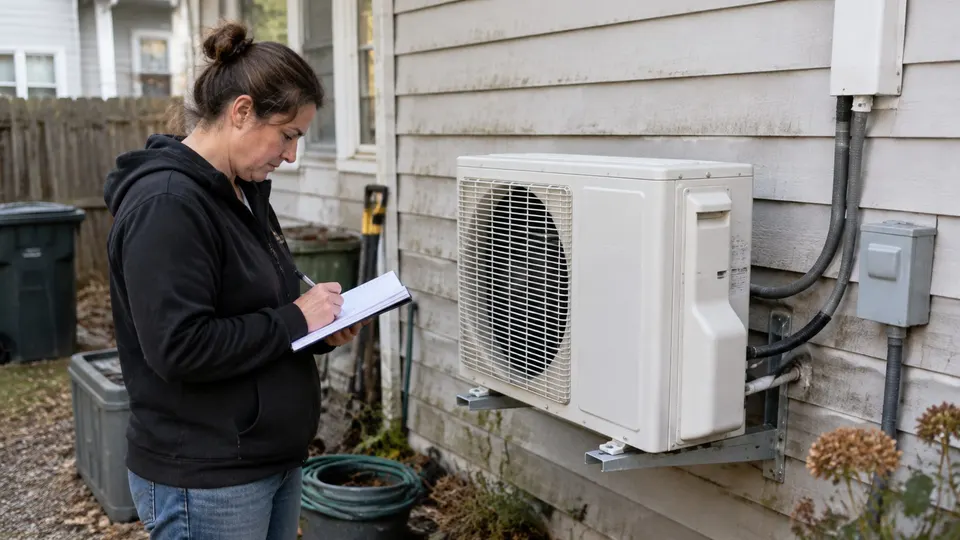
First check the remote's mode and set temperature. Then check whether the washable filters or the indoor intake are visibly blocked. If filters need cleaning, follow the shutdown and cleaning instructions in your model's manual; the mini split cleaning guide explains the basic routine.
From a safe distance, check whether leaves, snow or stored objects block the outdoor unit. Do not remove its covers, chip ice from the coil or reach inside. If ice is the issue, read the freezing-up checks before restarting.
Do not keep cycling the breaker to make a code disappear. If your manual calls for a restart, follow that exact procedure once after the safe checks. A returning code needs diagnosis, not repeated resets.
Give the technician a useful record
Send the exact code, both model numbers, when the fault appeared, and whether it happened in cooling or heating. Mention any recent power interruption. A photograph of the display and a short description of the symptom are more useful than a guessed part name.
Stop operation and seek service promptly for smoke, a burning smell, water near electrical parts or repeated breaker trips. Keep filters clean and outdoor airflow clear between services, but leave electrical and refrigerant work to qualified people.
Sources
- Daikin Global: error-code service page and equipment-family search.
- Daikin FTXS09/12H operation manual: ARC452A diagnosis and residential code table, fault diagnosis section.
- Daikin global self-diagnosis code list, for checking equipment-family scope, not mixing code meanings.